
Virtual Assistant Engagement Failures (And How to Ensure Long-Term Success)

Last updated on July 31st, 2026
Artificial intelligence (AI) is reshaping how organizations engage with customers, employees, and partners. Virtual assistants have become a strategic investment for enterprises seeking to improve customer experience, reduce operational costs, and deliver 24/7 support.
However, while AI adoption continues to accelerate, many organizations struggle to realize the expected value from their virtual assistant initiatives. A chatbot may launch with enthusiasm, only to see user adoption plateau. Customer satisfaction declines as unresolved queries increase, support teams become overwhelmed with escalations, and executives begin questioning the return on investment. More than the technology, the implementation strategy is the problem.
Understanding why virtual assistant engagements fail is critical for organizations planning a conversational AI initiative or looking to improve an existing deployment. Successful AI assistants are not one-time technology projects; they are ongoing business capabilities that require strategic planning, continuous optimization, governance, and collaboration across multiple teams.
This article explores the most common reasons virtual assistant engagements fail, the warning signs that indicate an initiative is off track, and the best practices organizations use to build sustainable, high-performing conversational AI programs.
Table of Contents
The 12 Biggest Reasons Virtual Assistant Engagements Fail
Warning Signs Your Engagement Is Failing
How Successful Organizations Prevent Virtual Assistant Engagement Failure
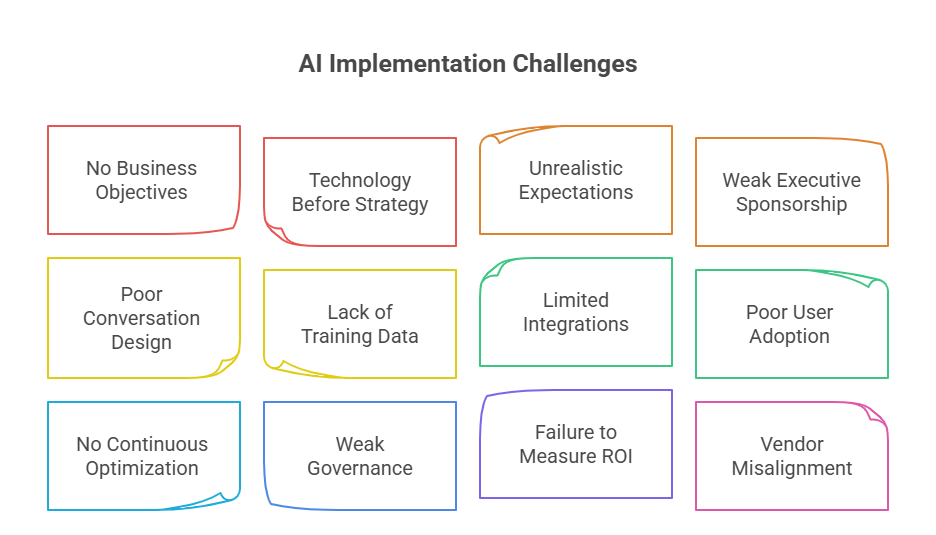
The 12 Biggest Reasons Virtual Assistant Engagements Fail
Most unsuccessful virtual assistant engagements aren’t caused by hiring the wrong person. They’re caused by unclear expectations, weak processes, and poor operational planning. Here are the 12 biggest reasons virtual assistant engagements fail.
1. No Clear Business Objectives
One of the most common virtual assistant implementation failures begins long before development starts. Organizations often deploy AI because competitors are doing it or because the technology is trending, rather than solving a clearly defined business problem.
Without measurable objectives, success becomes difficult to evaluate. Is the assistant supposed to reduce support tickets? Improve customer satisfaction? Increase self-service adoption? Shorten response times? Boost employee productivity? Different goals require different implementation strategies.
For example, a customer support chatbot designed to reduce call center volume will require different conversation flows, integrations, and KPIs than an internal HR assistant helping employees find policies.
Before deployment, organizations should establish goals such as reducing support call volume by 25% or increasing self-service resolution rates by 40%. Clear objectives align stakeholders, prioritize development efforts, and create meaningful benchmarks for measuring success.
Get the best virtual assistant for long-term success
2. Choosing Technology Before Strategy
Many organizations spend months evaluating AI platforms, natural language processing (NLP) engines, and chatbot vendors before they have determined what problems the virtual assistant should solve.
This technology-first approach often results in feature-rich solutions that lack business value. Instead of asking which AI platform we should buy, organizations should ask which customer journeys create the most friction and where automation can improve employee productivity.
Only after defining these priorities should technology selection begin. Successful conversational AI implementation starts with business strategy and user needs, not software features. The platform should support the strategy rather than dictate it.
3. Unrealistic AI Expectations
AI has advanced significantly, but it is not a magic solution capable of handling every customer interaction perfectly from day one.
Organizations often expect virtual assistants to understand every question, replace human agents completely, and deliver immediate ROI after launch. When these expectations aren’t met, stakeholders may prematurely label the initiative a failure.
The reality is that enterprise virtual assistants improve over time. They learn from user interactions, conversation analytics, feedback loops, and continuous refinement.
A successful deployment typically starts with low-complexity use cases and expands capabilities incrementally. Treating conversational AI as an evolving program rather than a finished product sets realistic expectations and creates a stronger foundation for long-term success.
4. Weak Executive Sponsorship
Many chatbot projects begin as isolated IT or customer service initiatives without strong executive backing. While technical teams can build a virtual assistant, organizational adoption requires leadership support.
Executive sponsorship is essential because virtual assistant initiatives often involve multiple departments, including customer service, IT, marketing, sales, and so on.
Without leadership alignment, projects frequently encounter roadblocks such as competing priorities, limited budgets, delayed integrations, and unclear ownership. Strong executive sponsors help by defining strategic priorities, securing funding and resources, removing organizational barriers, and aligning departments around common goals.
Organizations with active executive sponsorship are generally better positioned to scale their virtual assistant programs beyond initial pilot projects. Leadership involvement also reinforces accountability by ensuring success metrics, governance processes, and continuous improvement initiatives receive ongoing attention.
5. Poor Conversation Design
Even the most advanced AI platform cannot compensate for poorly designed conversations. Many organizations focus heavily on the technology behind the virtual assistant while overlooking the user experience.
A virtual assistant should guide users naturally toward a resolution. Instead, many implementations overwhelm users with lengthy menus, confusing prompts, or robotic responses that fail to understand intent. When users repeatedly receive irrelevant answers or find themselves stuck in endless loops, frustration quickly replaces confidence.
Effective conversation design starts with understanding real user behavior. Analyze common customer inquiries, map end-to-end user journeys, and design conversations that are intuitive, concise, and goal-oriented. Equally important is providing clear pathways to human support when the AI reaches its limitations.
Well-designed conversational flows increase task completion rates, improve customer satisfaction (CSAT), and encourage users to return to the assistant for future interactions.
6. Lack of Quality Training Data
Artificial intelligence is only as effective as the data it learns from. One of the leading causes of virtual assistant implementation failures is insufficient or poor-quality training data.
Organizations often launch virtual assistants using outdated FAQs, incomplete documentation, or inconsistent knowledge bases. As a result, the assistant struggles to recognize user intent, provides inaccurate responses, or fails to answer common questions altogether.
To build a high-performing virtual assistant, organizations should use diverse and representative training data. Training data should also evolve alongside the business. As products, policies, and customer needs change, the virtual assistant must be updated to reflect the latest information. Regular data reviews help maintain accuracy and reduce the risk of outdated or misleading responses.
7. Limited Integrations
A virtual assistant that cannot access enterprise systems has limited ability to resolve customer requests.
Many organizations deploy chatbots that can answer basic informational questions but cannot complete meaningful tasks because they lack integrations with business applications. Customers may be able to ask about an order but not check its status. Employees may locate an HR policy but cannot submit a leave request. These gaps create unnecessary friction and increase human escalations.
Successful AI-based virtual assistant deployment requires integration with Customer Relationship Management (CRM), Enterprise Resource Planning (ERP), and other systems.
The more context the assistant can securely access, the more personalized and valuable the user experience becomes. Integrations transform virtual assistants from simple information providers into intelligent digital assistants capable of completing real business tasks.
8. Poor User Adoption
Launching a virtual assistant does not guarantee that customers or employees will use it.
Low adoption often stems from limited awareness, lack of trust, or previous negative experiences with automated systems. If users perceive the assistant as inaccurate or difficult to use, they will quickly revert to traditional support channels.
Organizations should treat adoption as a change management initiative rather than a technology rollout. Monitoring usage patterns can also reveal barriers to adoption. If users abandon conversations early or repeatedly request human assistance, these insights can guide future improvements.
Ultimately, adoption depends on consistently delivering value. When users receive accurate answers and quick resolutions, engagement naturally increases.
9. No Continuous Optimization
Many organizations consider deployment the finish line. In reality, launch is only the beginning.
Customer questions evolve, products change, business processes are updated, and user expectations continue to grow. Without ongoing optimization, even a successful virtual assistant will gradually become less effective.
Continuous optimization should include reviewing conversation analytics, identifying unanswered questions, and improving intent recognition. Organizations that establish regular optimization cycles are better equipped to improve resolution rates, increase automation, and maximize long-term ROI.
10. Weak Governance
As virtual assistants become more sophisticated, governance becomes increasingly important.
Without clear governance, organizations risk inconsistent responses, outdated content, compliance issues, and unclear ownership of AI initiatives. Governance provides the framework needed to manage content quality, security, privacy, and operational accountability.
An effective AI governance model typically defines roles and responsibilities, content approval processes. data privacy, security standards, compliance requirements, and performance review schedules.
Governance also ensures that AI systems remain aligned with organizational policies and evolving regulatory requirements. For enterprise virtual assistants, governance is essential for building trust and maintaining long-term success.
11. Failure to Measure ROI
Organizations frequently invest significant time and resources into conversational AI but fail to establish meaningful performance metrics.
Without measurable outcomes, it becomes difficult to demonstrate business value or justify future investment. Beyond simple chatbot usage statistics, organizations should monitor metrics like return on investment, self-service resolution rate, containment rate, customer satisfaction (CSAT), average handling time, first contact resolution (FCR), and cost per interaction.
Tracking these KPIs helps identify opportunities for improvement while providing leadership with tangible evidence of the assistant’s business impact.
12. Vendor Misalignment
Selecting the wrong technology partner can significantly affect the success of a conversational AI initiative.
Some vendors focus primarily on software implementation, while others provide strategic consulting, conversation design, analytics, governance support, and long-term optimization. Organizations that prioritize cost over strategic fit often discover that their chosen vendor lacks the expertise required to support evolving business needs.
When evaluating vendors, consider different factors like industry experience, integration capabilities, scalability, security, and ongoing optimization services.
A successful vendor relationship should extend beyond implementation. The right partner works collaboratively to improve performance, expand capabilities, and ensure the virtual assistant continues delivering measurable business value.
Warning Signs Your Engagement Is Failing
Virtual assistant projects rarely fail overnight. More often, warning signs emerge gradually, providing organizations with opportunities to intervene before performance declines significantly.
Some of the most common indicators include:
- Low Adoption: If customers or employees consistently avoid using the assistant, it may indicate poor awareness, limited functionality, or a lack of trust in the experience.
- High Fallback Rate: Frequent fallback responses such as “I don’t understand” or repeated requests for clarification often signal gaps in training data, intent recognition, or conversation design.
- Poor Customer Satisfaction: Declining satisfaction scores suggest that users are not receiving accurate, relevant, or timely assistance. Monitoring qualitative feedback alongside CSAT can help uncover specific pain points.
- Increasing Escalations: While human handoffs are expected for complex cases, a steady increase in escalations may indicate that the assistant is unable to resolve routine requests effectively. This often points to integration gaps, outdated knowledge, or insufficient automation.
- Stagnant Knowledge Base: An AI assistant is only as valuable as the information it provides. If knowledge articles, FAQs, and training content are not regularly updated, response quality will deteriorate over time. A stagnant knowledge base often leads to outdated answers, inconsistent experiences, and declining user confidence.
How Successful Organizations Prevent Virtual Assistant Engagement Failure
While there are many reasons why virtual assistant engagements fail, organizations that consistently achieve strong outcomes share several best practices. They view conversational AI as a strategic business capability rather than a one-time technology implementation.
Successful virtual assistant engagements begin with a clear strategy that aligns AI initiatives with business objectives. Organizations should identify high-value use cases, define measurable success metrics, and involve key stakeholders across departments such as IT, customer service, operations, and compliance from the outset. Strong AI governance with clear ownership, security standards, compliance processes, and performance reviews helps ensure the virtual assistant remains accurate, secure, and aligned with organizational goals.
Long-term success also depends on continuous improvement and user adoption. Organizations should invest in change management, regularly update training data and conversation flows, monitor key performance metrics such as adoption, resolution rates, CSAT, and ROI, and use analytics to optimize performance. Equally important is designing seamless human handoffs so users can easily transition to a live agent when needed, creating a balanced experience that combines AI efficiency with human expertise.
Conclusion
Understanding why virtual assistant engagements fail is the first step toward building a successful conversational AI strategy. While many organizations encounter challenges such as unclear objectives, weak governance, poor conversation design, or limited integrations, these issues are preventable with the right planning and operational approach.
The most successful enterprise virtual assistants are not built through technology alone. They are supported by strong executive sponsorship, cross-functional collaboration, high-quality data, continuous optimization, and a commitment to improving the user experience over time.
Organizations that treat conversational AI as an evolving business capability are better positioned to increase adoption and improve customer satisfaction. As AI continues to advance, long-term success will depend less on selecting the perfect platform and more on establishing the processes and governance needed to help virtual assistants.
Frequently Asked Questions
1. Why do virtual assistant projects fail?
Most projects fail because organizations prioritize technology over business strategy. Common issues include unclear objectives, poor conversation design, weak governance, limited integrations, insufficient training data, and a lack of continuous optimization.
2. What is the biggest reason chatbot implementations fail?
The biggest reason is the absence of clearly defined business objectives. Without measurable goals and success metrics, organizations struggle to evaluate performance, prioritize improvements, or demonstrate ROI.
3. How long does it take to see ROI from a virtual assistant?
The timeline depends on the complexity of the deployment and the use cases being automated. Many organizations begin seeing measurable improvements in operational efficiency and customer experience within three to twelve months when the assistant is actively monitored and optimized.
4. How do you measure engagement success?
Success should be measured using a combination of operational, financial, and customer experience metrics rather than chatbot usage alone. Organizations typically evaluate adoption, containment, resolution rates, customer satisfaction, cost savings, and overall business impact.
5. How often should a virtual assistant be retrained?
There is no universal schedule, but organizations should review conversation analytics regularly and update training data whenever products, services, policies, or customer behaviors change. Quarterly optimization is a common best practice, while high-volume environments may require monthly updates.
6. What role does executive sponsorship play?
Executive sponsorship provides strategic direction, secures funding, removes organizational barriers, and keeps conversational AI initiatives aligned with broader business priorities. Strong leadership support significantly improves the likelihood of long-term success.
7. How can AI governance reduce project risk?
AI governance establishes policies for content management, compliance, security, privacy, performance monitoring, and accountability. A robust governance framework helps organizations maintain consistent, trustworthy, and compliant virtual assistant experiences while reducing operational and regulatory risks.

Vgrow