Home / Blog / Benefits of Virtual Assistant Data Entry Services: Save Time, Reduce Costs & Improve Accuracy
Benefits of Virtual Assistant Data Entry Services: Save Time, Reduce Costs & Improve Accuracy
Last updated on August 12th, 2026
Data entry rarely gets the attention it deserves until it starts slowing everything else down. Order details go unrecorded, inventory counts drift from reality, and customer records pile up faster than internal teams can process them. For growing businesses, this backlog often signals a deeper problem: skilled employees are spending hours on repetitive tasks instead of the work they were actually hired to do.
Virtual assistants have become a practical answer to this bottleneck. Rather than adding full-time headcount for a function that rarely requires a dedicated in-house role, businesses are turning to remote data entry support to keep records accurate and operations moving. This article breaks down why that shift makes sense, the specific advantages it delivers, the mistakes companies should avoid when adopting it, and the questions most commonly asked before making the switch.
Table of Contents
Why Virtual Assistants Are Crucial for Data Entry Services
Why Virtual Assistants Are Crucial for Data Entry Services
Data entry sits at an unusual intersection: it is essential to daily operations but rarely strategic enough to justify a full-time hire in most small and mid-sized companies. Someone still has to update spreadsheets, migrate records between systems, and verify that customer or product information is correct. When that work falls to existing staff, it competes directly with higher-value responsibilities like sales, account management, or product development.
Virtual assistants close this gap by handling data entry as their core function rather than a task squeezed between other priorities. A company can scale data entry support up during peak seasons or product launches, then scale back down without the complications of layoffs or reassignment. This flexibility, paired with lower overhead, is why data entry has become one of the most commonly outsourced back-office functions across ecommerce, healthcare, real estate, and professional services.
Top Benefits of Virtual Assistant Data Entry Services
The advantages of outsourcing data entry extend beyond simple cost savings. Each benefit below addresses a specific operational pain point that businesses encounter as they grow.
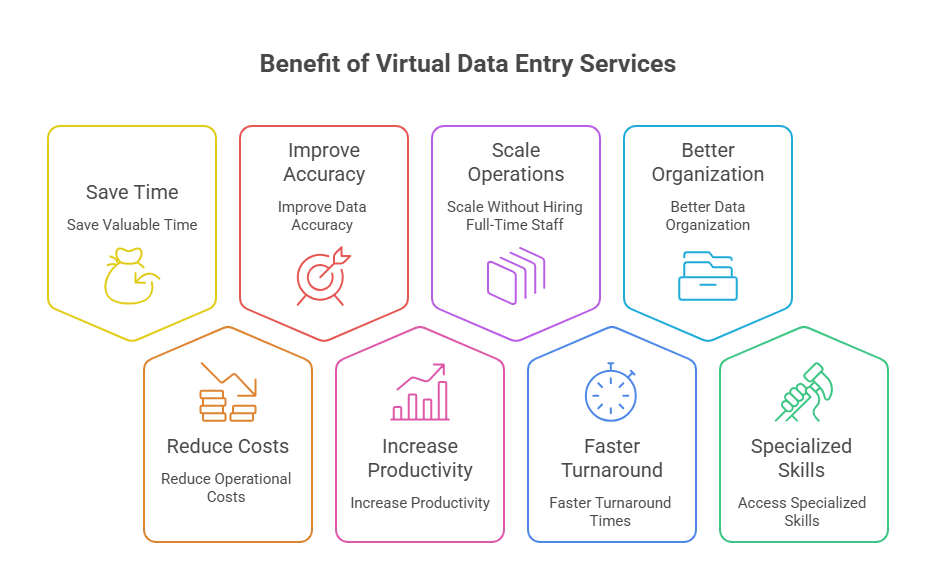
Save Valuable Time
Virtual assistants take over repetitive data entry tasks, allowing internal employees to spend less time on manual work and more time on strategic responsibilities such as customer acquisition, process improvement, and business development.
Reduce Operational Costs
Outsourcing data entry can reduce the costs associated with hiring full-time employees. Businesses can avoid expenses related to salaries, benefits, office space, equipment, and other overhead costs while still maintaining reliable data entry support.
Improve Data Accuracy
Dedicated data entry specialists work with structured processes and quality checks to maintain accurate records. This helps reduce the mistakes that can occur when data entry is handled inconsistently by employees who have other responsibilities.
Increase Productivity
When routine data entry is delegated to virtual assistants, internal teams can focus on their core responsibilities with fewer interruptions. This allows projects to move forward faster and improves overall team productivity.
Scale Without Hiring Full-Time Staff
Virtual assistant support can expand or contract according to workload. Businesses can increase data entry capacity during seasonal peaks, product launches, or periods of rapid growth without committing to permanent full-time hires.
Achieve Faster Turnaround Times
Many virtual assistant providers work across different time zones, allowing data entry tasks to continue outside regular business hours. As a result, records may be updated overnight and ready for internal teams to review the following business day.
Improve Data Organization
Virtual assistants can follow standardized formatting, naming conventions, and data entry procedures to keep records consistent. Better-organized data is easier to search, audit, update, and use across different departments.
Access Specialized Skills
Businesses can work with data entry specialists who are already familiar with tools such as spreadsheets, CRM platforms, ecommerce backends, and industry-specific databases. This reduces the need to train internal employees from scratch and helps businesses maintain consistent workflows.
Common Mistakes to Avoid
Outsourcing data entry works well when it is set up correctly, but a few recurring mistakes can undermine the results.
Poor onboarding is the most common issue. When a virtual assistant starts without a clear understanding of the systems, formatting standards, or data sources involved, early output tends to require significant rework. Related to this is a lack of documentation. Businesses that fail to provide reference guides, naming conventions, or examples of correctly formatted entries leave too much open to interpretation, which leads to inconsistency over time.
Skipping quality checks is another frequent problem. Even experienced virtual assistants benefit from a review process, particularly in the first few weeks of an engagement. Without spot checks or periodic audits, small errors can go unnoticed until they affect downstream reporting or customer-facing records.
Over-permissioning introduces unnecessary risk. Granting broader system access than a task actually requires increases exposure if credentials are mishandled or if the assistant’s role changes. Finally, unrealistic expectations around ramp-up time can create friction on both sides. Most data entry engagements improve in speed and accuracy after an initial adjustment period, and treating that period as a red flag rather than a normal part of onboarding often leads to premature turnover.
Frequently Asked Questions
1. Can a virtual assistant handle sensitive data?
Yes, provided the engagement includes proper safeguards. This typically means signed confidentiality agreements, role-based system access, and adherence to relevant data protection standards for the industry involved, such as healthcare or financial services.
2. How much do data entry VA services cost?
Pricing varies based on task complexity, volume, and the provider’s location and experience level. Businesses typically pay significantly less than the fully loaded cost of a full-time in-house employee, though exact rates depend on the scope of work agreed upon.
3. What software should they know?
This depends on the business’s existing tools. Common requirements include spreadsheet software, CRM platforms, ecommerce backend systems, and industry-specific databases. Most providers can match assistants to the specific software stack a business already uses.
4. How quickly can they start?
Many providers can onboard a virtual assistant within a few days to a couple of weeks, depending on the complexity of the systems involved and how much training or documentation is required upfront.
5. Can they work across time zones?
Yes, and this is one of the practical advantages of outsourcing. Time zone differences allow data entry to happen overnight relative to the business’s home market, so updated records are often ready by the start of the next business day.
6. What industries benefit most?
Ecommerce, healthcare, real estate, logistics, and professional services see particularly strong results, since these industries generate high volumes of structured data that require consistent, ongoing entry and maintenance.
Conclusion
Virtual assistant data entry services address a problem that most growing businesses eventually face: routine data work that consumes time without requiring a dedicated full-time role. The benefits, from cost savings and improved accuracy to scalability and faster turnaround, make a strong case for outsourcing this function rather than absorbing it into already stretched internal teams.
The right decision depends on current workload, budget, and growth trajectory. Businesses handling a steady or increasing volume of records, without the internal bandwidth to manage it accurately, are typically the best candidates for this kind of support.

Vgrow