
How Real Estate Virtual Assistants Manage Online Reviews to Build Trust

Last updated on August 4th, 2026
A single unanswered negative review on Google can sit at the top of an agent’s business profile for months, shaping the first impression of every prospect who searches their name. Most agents know reviews matter, but few have the bandwidth to monitor multiple platforms, respond within a reasonable window, and run a consistent process for requesting new feedback after every closing. That gap is where a real estate virtual assistant becomes valuable: not as a replacement for the agent’s voice, but as the person who makes sure that voice shows up consistently everywhere buyers and sellers are looking.
This article breaks down how real estate VAs manage online reviews from monitoring through response, the systems they use to generate more reviews without sounding pushy, the tools that make this workflow scalable, and what to look for when hiring one.
Table of Contents
Why Online Reviews Matter in Real Estate
How Real Estate Virtual Assistants Manage Online Reviews
How VAs Help Generate More Reviews
Tools Used for Review Management
Best Practices for Responding to Reviews
How to Hire a Real Estate Virtual Assistant for Review Management
Why Online Reviews Matter in Real Estate
Real estate is a high-trust, high-stakes transaction. Buyers and sellers are not choosing a product off a shelf. They are choosing someone to guide them through one of the largest financial decisions they will make, and that decision is rarely based on a listing photo alone.
Reviews function as a proxy for trust before a prospect ever picks up the phone. A profile with a steady stream of recent, detailed reviews signals that an agent is actively working with clients right now, not coasting on reputation built years ago. A profile with a handful of old reviews, or worse, one unanswered complaint sitting at the top, signals the opposite.
Reviews also carry weight beyond the person reading them. Google’s local ranking algorithm factors in review quantity, recency, and response rate when determining which agents appear in local map results for searches like “realtor near me” or “best real estate agent in [city].” An agent who never asks for reviews, or who asks inconsistently, is effectively opting out of a ranking signal their competitors are actively building.
Deploy virtual assistants to manage your real estate businesses
The conversion impact compounds from there. A prospect comparing three agents will often use reviews as the tiebreaker, especially when pricing and experience look similar on paper. Detailed reviews that mention specific outcomes, responsiveness, or how an agent handled a difficult negotiation do more to build confidence than a generic five-star rating with no text attached.
How Real Estate Virtual Assistants Manage Online Reviews
Review management is not a single task. It is a recurring workflow with several distinct components, each of which a VA typically owns end to end.
Monitoring New Reviews Daily
The first responsibility is simply catching new reviews as they come in. Waiting a week to notice a review, especially a negative one, means the agent has already lost the window where a fast response would have made the strongest impression. A real estate VA typically sets up daily monitoring across every platform the agent has a presence on, using either native notification settings or a reputation management dashboard that consolidates alerts into one place.
Daily monitoring also means the VA can flag patterns early. If three reviews in a month mention slow communication during closing, that is useful operational feedback the agent needs to hear before it becomes a recurring theme in public reviews.
Responding to Positive and Neutral Reviews
Every review deserves a response, including the five-star ones. A thoughtful reply to a positive review reinforces the specific thing the client praised, whether that was responsiveness, negotiation skill, or local market knowledge, and it signals to future readers that the agent is engaged and appreciative rather than passively collecting stars.
Neutral reviews, typically three or four stars with mild criticism, require more care. These often contain useful, specific feedback wrapped in otherwise positive language. A VA responding on the agent’s behalf will usually acknowledge the specific point raised, thank the client for the detail, and avoid being defensive, since a neutral review with a well-handled response can read as more credible to future prospects than an unbroken string of five-star reviews with no nuance at all.
Handling Negative Reviews and Escalating Sensitive Issues
Negative reviews are where review management earns its value. A VA’s role here is procedural rather than improvised: acknowledge the concern without admitting fault that has not been established, avoid arguing in public, and move the conversation toward a private resolution channel such as a phone call or email.
Not every negative review can or should be handled by the VA alone. Reviews that involve legal exposure, allegations of discrimination, fair housing concerns, or accusations that could affect licensing require immediate escalation to the agent or broker rather than a standard templated response. A well-run VA workflow includes a clear escalation trigger list so the VA knows exactly which categories of complaint get flagged immediately rather than handled independently. This protects both the agent’s reputation and their legal standing, since an improperly worded public response to a sensitive complaint can create more exposure than the original review.
Maintaining Brand Voice Across Platforms
An agent’s tone on Google should sound like the same person responding on Zillow or Facebook. VAs typically work from a documented voice guide, covering things like whether the agent signs responses with their first name, how formal the language should be, and which phrases to avoid. This consistency matters more than it might seem, since prospects who check an agent across multiple platforms, which many do before reaching out, will notice if the tone feels inconsistent or clearly templated.
How VAs Help Generate More Reviews
Managing existing reviews is only half the job. The other half is making sure new reviews come in consistently, since a profile that stalls at the same review count for a year looks less credible than one that grows steadily after every closing.
Automated Email and SMS Follow-Ups
The most common method is a timed follow-up sequence sent shortly after closing, when the transaction is fresh and the client’s experience is still top of mind. VAs typically set these up through email and SMS platforms with built-in scheduling, so the request goes out automatically rather than depending on the agent remembering to send it. SMS tends to produce a faster response rate given how frequently people check text messages compared to email, so many workflows use a short SMS nudge followed by a more detailed email with direct links to the agent’s preferred review platforms.
Post-Closing Review Campaigns
Beyond a single automated message, some VAs run a short, structured campaign around each closing: a thank-you message immediately after closing, a review request a few days later once the initial busyness has settled, and a final reminder for clients who have not responded within a set window. This staged approach tends to outperform a single one-off request because it gives the client more than one natural opportunity to act without feeling repeatedly pressured.
CRM-Based Review Requests
Agents working with any volume of transactions typically rely on a CRM to track where each client is in the post-closing sequence. A VA manages this inside the CRM directly, triggering review requests based on a closing date field rather than manually tracking who needs a follow-up. This also allows the VA to segment requests, since a first-time buyer with a smooth transaction is often a stronger candidate for a detailed testimonial than a client who experienced delays outside the agent’s control.
Tools Used for Review Management
The specific tool stack varies by agent, but most review management workflows rely on a similar set of categories.
| Tool | Primary Purpose | What It Handles |
| Google Business Profile | Local search visibility | Review monitoring, direct responses, Q&A management |
| Zillow Dashboard | Real estate-specific reviews | Client testimonials tied directly to listings and transactions |
| CRM Systems | Client and transaction tracking | Automated review request triggers, client segmentation |
| Reputation Management Software | Cross-platform monitoring | Consolidated alerts, response tracking, sentiment trends |
| AI Writing Assistants | Response drafting support | First-draft replies for the VA to review and personalize before posting |
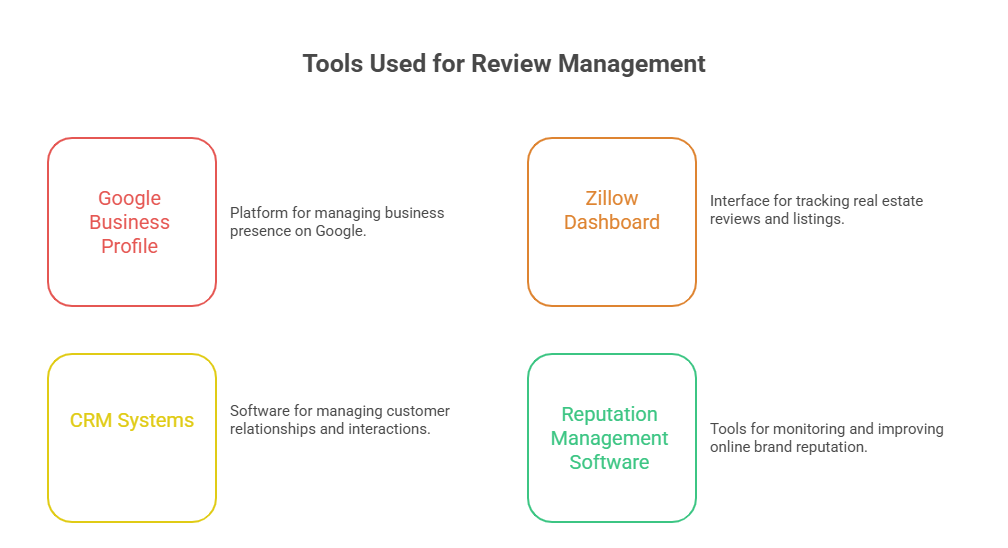
Reputation management software is often the piece that makes daily monitoring realistic once an agent is active on more than two or three platforms, since checking each one manually every day is not a sustainable process. AI writing tools speed up response drafting, but the instructions given to a VA typically require a human review step before anything goes live publicly, since a review response tied to a real client situation carries more risk if it is posted without a final check.
Best Practices for Responding to Reviews
The tone and structure of a response often matter as much as the content. The examples below are illustrative templates, not real client interactions, and are meant to show the shape a good response takes rather than exact wording to copy.
Positive review response: A short, specific reply that names what the client praised and thanks them by name tends to perform better than a generic “thanks for the kind words.” Something like: “Thank you, [Name], for the detailed feedback on the negotiation process. It was a pleasure helping you find the right home in [neighborhood].”
Neutral review response: Acknowledging the specific concern while staying appreciative works better than a purely defensive tone: “Thank you for the honest feedback, [Name]. We’re glad the overall experience was positive, and I’ve noted your point about communication timing for future transactions.”
Negative review response: A brief, non-defensive acknowledgment paired with an invitation to resolve privately: “I’m sorry to hear about your experience, [Name]. I’d like to understand what happened and make it right. Please reach out to me directly at [contact] so we can discuss this further.”
Reviews that should be escalated: Any review referencing potential fair housing violations, discrimination, legal disputes, or licensing complaints should go straight to the agent or broker rather than receiving a standard templated reply, since these carry legal and regulatory implications beyond typical customer service.
How to Hire a Real Estate Virtual Assistant for Review Management
Skills to look for: Strong written communication, familiarity with real estate terminology and transaction stages, and comfort working inside a CRM are the baseline requirements. Experience with reputation management software is a plus but can often be trained if the other fundamentals are strong.
Experience to prioritize: A VA who has worked specifically in real estate, or at least in a client-facing service industry with similar trust dynamics, will typically need less onboarding than someone coming from an unrelated field.
Interview questions worth asking:
| Question | What It Reveals |
| How would you respond to a review that unfairly blames the agent for a delay outside their control? | Judgment and tone under pressure |
| What would make you escalate a review instead of responding directly? | Understanding of risk and boundaries |
| How do you typically structure a post-closing follow-up sequence? | Process knowledge and familiarity with CRM workflows |
Recommended workflow to set up on day one: A documented voice guide, a clear escalation trigger list, access to the CRM and each review platform, and a defined response-time expectation (commonly within 24 to 48 hours) give a new real estate VA everything needed to manage reviews consistently from the start rather than improvising an approach.
Frequently Asked Questions
1. Can a virtual assistant respond to Google reviews?
Yes, provided they have manager-level access to the Google Business Profile. Most agents grant this access directly or through a reputation management platform, allowing the VA to respond on the agent’s behalf using an agreed tone and escalation process.
2. How often should online reviews be monitored?
Daily monitoring is standard for active agents. Waiting longer risks a delayed response to negative reviews, which tends to look worse to prospects than the original complaint itself.
3. Which review platforms matter most for real estate agents?
Google Business Profile and Zillow typically carry the most weight, since they combine high search visibility with real estate-specific credibility. Facebook and niche local directories can matter depending on the agent’s market.
4. Can a VA automate review requests?
Yes. Most VAs set up automated email and SMS sequences triggered by a closing date in the CRM, removing the need for the agent to remember to send requests manually.
5. How do online reviews improve local SEO?
Google’s local ranking algorithm considers review quantity, recency, and response rate as part of how it ranks businesses in local map results, making consistent review activity a factor in search visibility, not just reputation.
6. What tools are best for managing real estate reviews?
A combination of a CRM for tracking and automation, a reputation management platform for cross-channel monitoring, and direct access to Google Business Profile and Zillow covers most of what an active agent needs.
Conclusion
Managing online reviews is not a one-time task but an ongoing operational process, and it is exactly the kind of consistent, detail-driven work a real estate virtual assistant is well suited to own. From daily monitoring and thoughtful responses to structured review generation campaigns, a VA gives agents a reliable system for building trust at scale rather than relying on inconsistent, reactive effort. The result is a stronger local search presence, a more credible reputation, and a steadier pipeline of leads who have already seen evidence that past clients trust the agent before the first conversation even happens.

Vgrow