
Top 6 Virtual Assistants for Real Estate That Save Time and Increase Efficiency

Last updated on December 29th, 2025
Real estate companies are currently navigating a “perfect storm” of external pressures, including fluctuating inflation, high mortgage rates, and shifting demographics. However, the most critical hurdles are often internal: inefficient workflows and stagnant back-office processes that prevent firms from scaling.
With nearly $1.8 trillion in commercial real estate loans set to mature through 2026, the margin for error has disappeared. To survive this liquidity crunch and maintain growth, firms are increasingly turning to Real Estate Virtual Assistants to bridge the gap in three key areas:
- Operational Agility: VAs eliminate the overhead of full-time in-house staff, allowing firms to scale their administrative support up or down instantly in response to economic shifts.
- Financial Precision: By leveraging VAs specialized in real estate bookkeeping and data entry, firms can solve chronic issues like inaccurate financial reporting and poor cash flow management.
- Strategic Focus: Outsourcing repetitive tasks—such as lead coordination, regulatory compliance tracking, and CRM management—frees up principals to focus on high-stakes loan restructuring and portfolio strategy.
Table of Contents
Why Virtual Assistants Matter in Real Estate
What to Look for in a Real Estate Virtual Assistant
Top 6 Virtual Assistants for Real Estate
How Virtual Assistants Improve Efficiency
The Strategic Advantage of Vgrow in a Volatile Market
Why Vgrow is the “Infrastructure for Profitability”
Why Virtual Assistants Matter in Real Estate
In an era of maturing debt and technological disruption, the ability to operate lean is no longer just an advantage; it is a necessity. Real estate virtual assistants provide the cost-effective infrastructure required to navigate this complex landscape and emerge profitable.
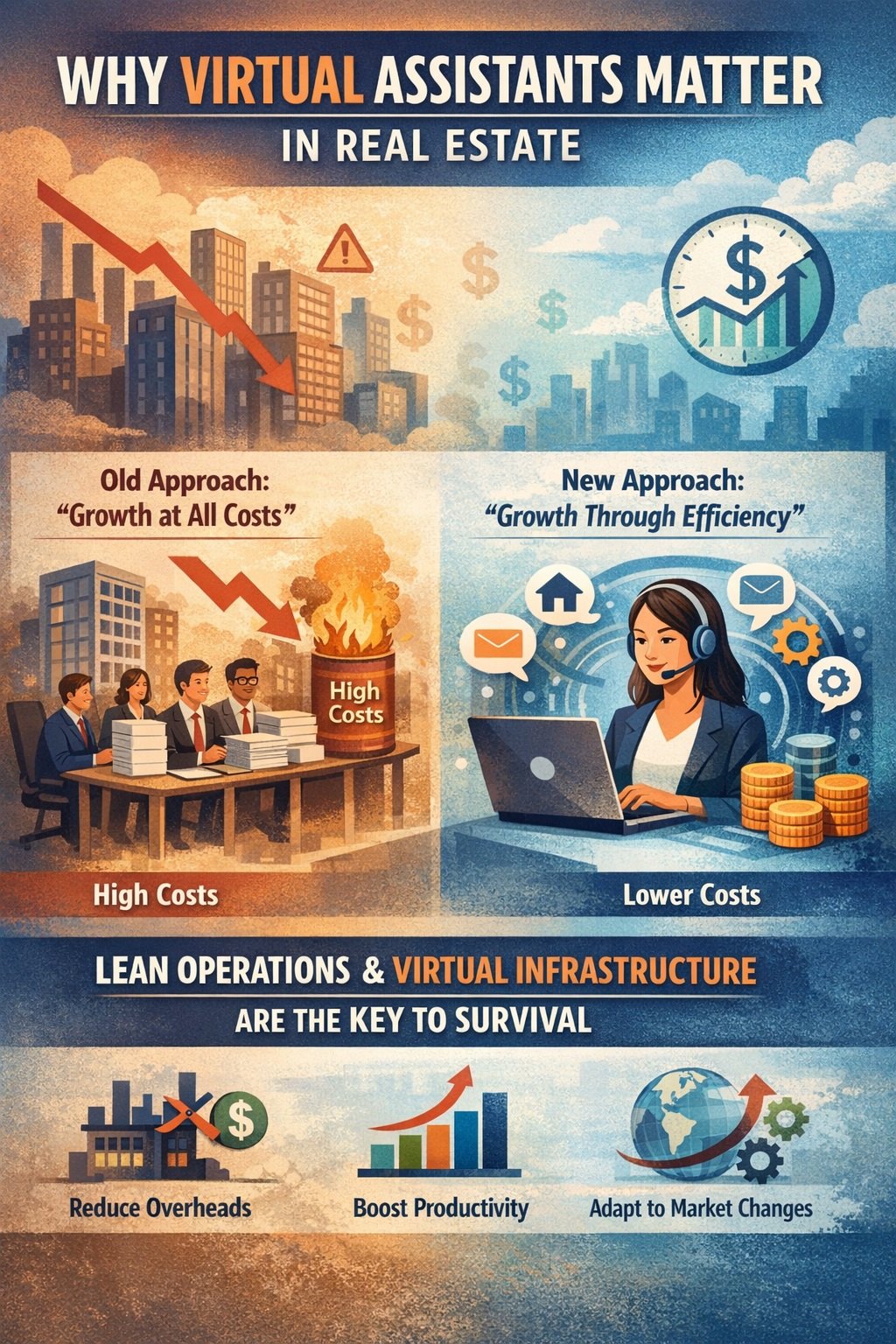
There should be a fundamental shift in the real estate industry: the transition from “growth at all costs” to “growth through efficiency.” When capital was cheap, firms could afford bloated payrolls and manual workflows. Today, that is a recipe for failure.
Here is a deeper look at why lean operations and virtual infrastructure have become the modern standard for survival.
1. The Debt Wall: A Catalyst for Efficiency
With $1.8 trillion in commercial loans maturing by 2026, many firms are facing “the debt wall.” As these loans come due for refinancing at significantly higher interest rates, debt service coverage ratios (DSCR) are tightening.
- The Reality: If interest expenses double, the only way to maintain profitability is to slash operating expenses (OpEx). *
- The VA Solution: Virtual assistants allow firms to maintain high-level output at a fraction of the cost of local hires. By converting fixed labor costs into variable costs, firms can protect their bottom line even as debt costs rise.
2. Navigating Technological Disruption
The “PropTech” revolution has introduced powerful tools for CRM, automated marketing, and AI-driven analytics. However, these tools are only effective if someone is managing them.
- The Reality: Most real estate principals are too busy closing deals to master new software, leading to “digital clutter”, paying for tools that aren’t being used.
- The VA Solution: A tech-savvy virtual assistant acts as the bridge between the software and the strategy. They ensure the CRM is updated, data is cleaned, and automated workflows are actually running, ensuring the firm gets a true ROI on its technology investments.
3. The “Lean” Necessity
Operating “lean” doesn’t mean doing less; it means doing more with a smaller core of high-value decision-makers.
- Agility: In a volatile market, the ability to pivot is vital. A lean firm can scale down during a dip without the trauma of mass layoffs, and scale up during a boom without the long lead time of traditional hiring.
- Focus: Every hour a senior broker or developer spends on data entry or document coordination is an hour lost on revenue-generating activities. Virtual assistants provide the infrastructure of support that allows the “brain trust” of the company to stay focused on high-level navigation.
4. Emerging Profitable
Profitability in the next decade will be defined by operational leverage.
The Formula: Revenue – (Reduced OpEx) = Sustainable Profit
By utilizing a global talent pool, real estate firms can build a 24/7 “follow-the-sun” workflow. While the local team sleeps, virtual assistants can process leads, update financial models, and prepare closing documents. This around-the-clock productivity, achieved at a lower cost basis, is what allows a firm to not just survive the “complex landscape” but to actually expand while competitors are retracting.
What to Look for in a Real Estate Virtual Assistant
Not all virtual assistant services real estate professionals use are created equal. The most effective support includes:
- Industry specific experience with real estate workflows
- Familiarity with CRM platforms and listing tools
- Strong communication and attention to detail
- Scalable support that grows with your business
The goal is not just delegation, but operational efficiency.
Top 6 Virtual Assistants for Real Estate
1. VGrow Real Estate Virtual Assistant Services
VGrow offers a comprehensive real estate virtual assistant service designed specifically for brokers, agents, and property investors. Their assistants handle lead qualification, CRM updates, listing coordination, appointment scheduling, and marketing support.
What sets VGrow apart is its platform driven approach. Business owners receive consistent support, clear reporting, and scalable resources without micromanagement. This makes it an excellent option for teams looking to hire a real estate virtual assistant that integrates smoothly into existing operations.
2. Task Based Real Estate Assistants
Task based assistants specialize in handling repetitive administrative functions such as data entry, document organization, and transaction checklists. These services are ideal for agents who already have systems in place but need reliable execution.
While limited in strategic support, they help maintain workflow consistency and reduce backlogs during peak seasons.
3. Lead Management Virtual Assistants
Lead focused virtual assistants concentrate on responding to inquiries, qualifying prospects, and scheduling appointments. They ensure no opportunity slips through the cracks.
For growing brokerages, this type of real estate virtual assistant service improves response time and client satisfaction without increasing internal headcount.
4. Marketing Focused Real Estate Virtual Assistants
These assistants support content scheduling, email campaigns, social media posting, and basic design coordination. Their role is to keep your brand visible while you focus on client relationships.
When paired with a solid marketing strategy, they help maintain a consistent online presence that attracts inbound leads.
5. Transaction Coordination Virtual Assistants
Transaction coordinators manage paperwork, deadlines, and communication between buyers, sellers, and lenders. They reduce errors and ensure compliance throughout the closing process.
This option is particularly valuable for high volume agents who need accuracy and organization without distractions.
6. Hybrid Virtual Assistant Services
Hybrid services combine administrative, marketing, and lead support under one model. They are ideal for business owners who want flexibility without hiring multiple vendors.
Many consider this approach the best real estate virtual assistant solution because it adapts as business needs evolve.
How Virtual Assistants Improve Efficiency
When you hire a real estate virtual assistant, the impact extends beyond time savings. You gain:
- Faster lead response and follow up
- Cleaner CRM data and reporting
- Improved client experience
- Better work life balance
Over time, these improvements translate into higher close rates and sustainable growth.
The Strategic Advantage of Vgrow in a Volatile Market
In an era defined by maturing debt and rapid disruption, the difference between a firm that survives and one that thrives is the quality of its infrastructure. Vgrow isn’t just a staffing agency; it is a strategic partner that builds the “cost-effective infrastructure” mentioned in your thesis.
1. Specialization Over Generalization
The “complex landscape” of 2026 requires more than just basic administrative help. It requires industry-specific expertise.
- The Vgrow Edge: Unlike general VA providers, Vgrow specializes in the real estate ecosystem. Our VAs understand the nuances of commercial leases, REO workflows, and the urgency of loan maturation deadlines. This means zero “learning curve” costs for your firm.
2. Solving the “Debt Wall” with Operational Leverage
When interest rates rise, your internal “Cost per Acquisition” (CPA) must go down to maintain margins.
- The Vgrow Edge: Vgrow allows firms to replace high-overhead local salaries with a high-output virtual model. By offloading property management coordination, financial reporting, and lead nurturing to Vgrow, you drastically lower your operating expenses, creating the liquidity cushion needed to handle maturing commercial loans.
3. Turning Disruption into Data
Technological disruption is only a threat if you can’t keep up. Vgrow VAs are experts in the tools that define modern real estate, from Buildium and AppFolio to kvCORE and CoStar.
- The Vgrow Edge: We don’t just provide a person; we provide a “system-ready” professional. Vgrow VAs ensure your data is clean and your reports are accurate, providing the “Financial Precision” necessary to navigate high-stakes refinancing and demographic shifts.
4. Scalability Without the Friction
The biggest risk of “leaning out” is losing the ability to grow when an opportunity arises.
- The Vgrow Edge: Vgrow provides frictionless scaling. If a firm suddenly needs to audit a massive portfolio for a $100M refinance, Vgrow can deploy a dedicated team faster than a traditional HR department can even post a job description.
Why Vgrow is the “Infrastructure for Profitability”
Vgrow’s model is designed to move your firm from a fixed-cost burden to a variable-cost advantage. By integrating Vgrow into your workflow, you aren’t just surviving the era of maturing debt; you are re-tooling your business to be leaner, faster, and more profitable than the competition.
The Vgrow Verdict: In a complex landscape, you don’t need more employees, you need more capacity. Vgrow delivers that capacity at a price point that makes profitability an inevitability, not a hope.
Frequently Asked Questions
1. How many hours should I start with for a real estate virtual assistant?
Most business owners start with 20 to 40 hours per month and adjust as workload increases.
2. Can a virtual assistant handle my CRM and listings?
Yes. Most real estate virtual assistant services are trained to manage CRMs, listings, and transaction updates.
3. Is it secure to outsource real estate tasks?
Reputable providers follow data security and confidentiality standards to protect client information.
4. How quickly can I see results after hiring a virtual assistant?
Many agents notice improved efficiency within the first few weeks.
Final Thoughts
Choosing the right virtual assistant is less about cost and more about fit. The best support aligns with your workflow, understands real estate operations, and scales with your goals. Whether you need administrative relief or full operational support, the right virtual assistant services real estate professionals rely on can transform how your business runs.

Vgrow